
On This Page
A few months ago, I read an excellent book by Allan Dib titled The 1-Page Marketing Plan: Get New Customers, Make More Money, and Stand Out From the Crowd. It’s the inspiration for this resource.
The book presents a simple yet comprehensive approach to developing a business’s marketing plan on a single page.
While I love the approach, the book wasn’t written for law firms. Therefore, I decided to build my own version, and give it away for free.
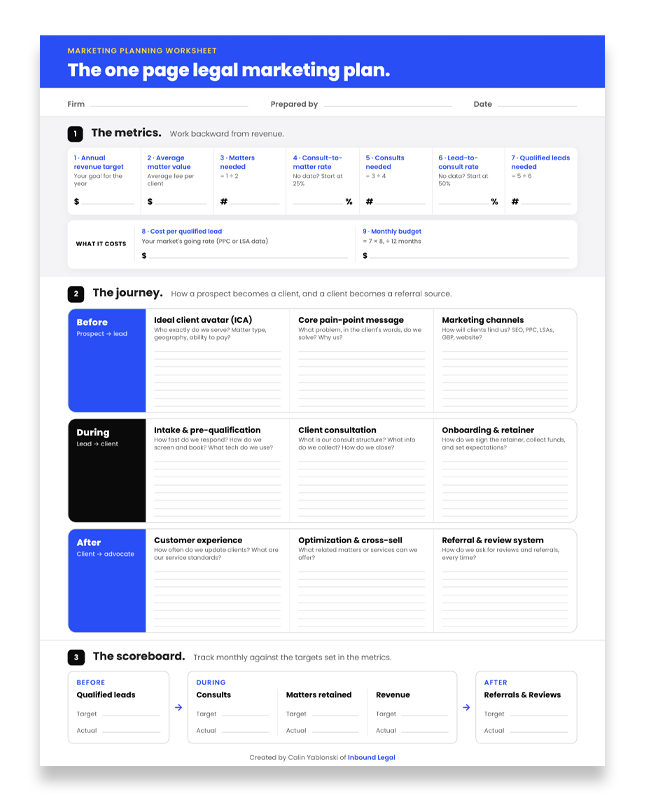
It is a single worksheet with three sections: the metrics, the journey, and the scoreboard.
When it is filled out properly, it converts your revenue goals into a specific lead target and a defensible monthly budget, documents how prospects become clients, and gives you a monthly scoreboard that tells you exactly what’s working, and what’s not.
You can download it below and use the following sections as a guide.
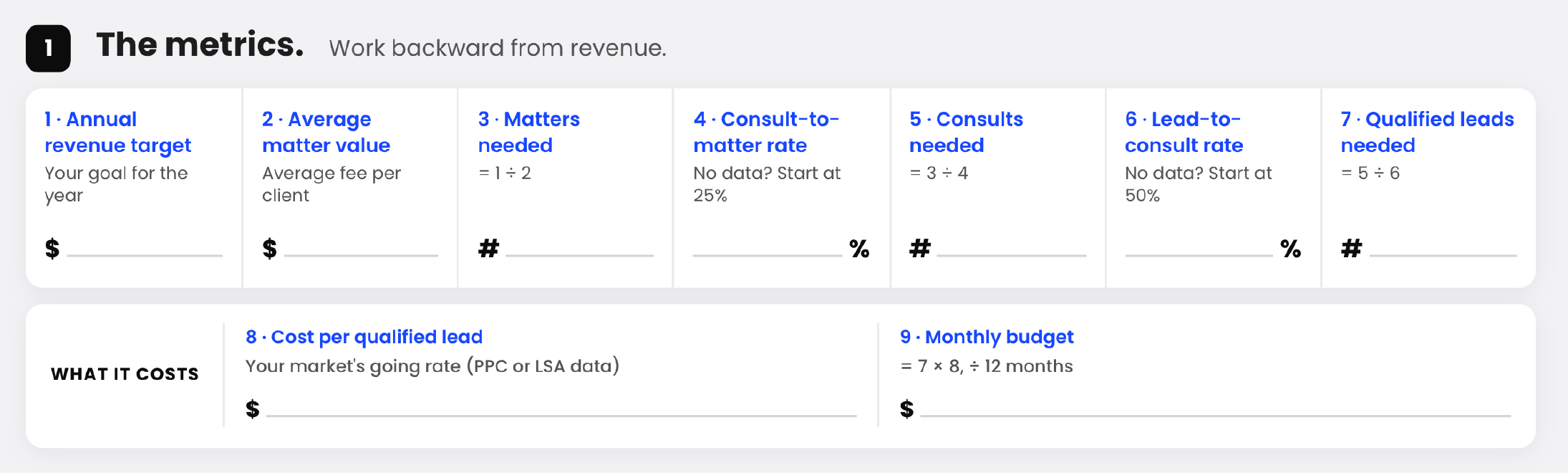
This is the engine of the whole sheet. Nine fields, and each one feeds the next. You start with the revenue you want and end with the marketing budget required to produce it.
Here’s a simple example.
| Field | Example | How you get it |
|---|---|---|
| 1. Annual revenue target | $1,000,000 | Your goal for the year |
| 2. Average matter value | $8,000 | Total fees last year ÷ matters retained |
| 3. Matters needed | 125 | Field 1 ÷ Field 2 |
| 4. Consult-to-matter rate | 25% | Your CRM data, or start at 25% |
| 5. Consults needed | 500 | Field 3 ÷ Field 4 |
| 6. Lead-to-consult rate | 50% | Your intake data, or start at 50% |
| 7. Qualified leads needed | 1,000 | Field 5 ÷ Field 6 |
| 8. Cost per qualified lead | $150 | Google Ads / LSA benchmarks for your market |
| 9. Monthly budget | $12,500 | Field 7 × Field 8, ÷ 12 months |
How to fill it out
Fields 1 and 2 come from your own numbers.
Your revenue target is whatever you have committed to for the year. Your average matter value is total fees collected divided by matters retained. Pull it from your billing system, not from memory. Firms consistently overestimate this number.
Fields 3, 5, 7, and 9 are pure arithmetic.
The sheet prints the formula under each one. Divide, divide, divide, multiply. No judgment calls.
Fields 4 and 6 are your conversion rates.
Consult-to-matter rate is the percentage of consultations that sign a retainer. Lead-to-consult rate is the percentage of qualified leads that show up to a consultation. If you track these, use your real numbers. If you do not, start with the defaults printed on the sheet: 25% and 50%. They are conservative industry baselines, and you will replace them with real data within a quarter.
Field 8 is the market rate, not your wish.
Cost per qualified lead comes from what Google Ads and Local Services Ads actually charge in your practice area and city. A personal injury lead in a major market can cost several times what a family law lead costs in a smaller one. Use benchmark data or your own campaign history.
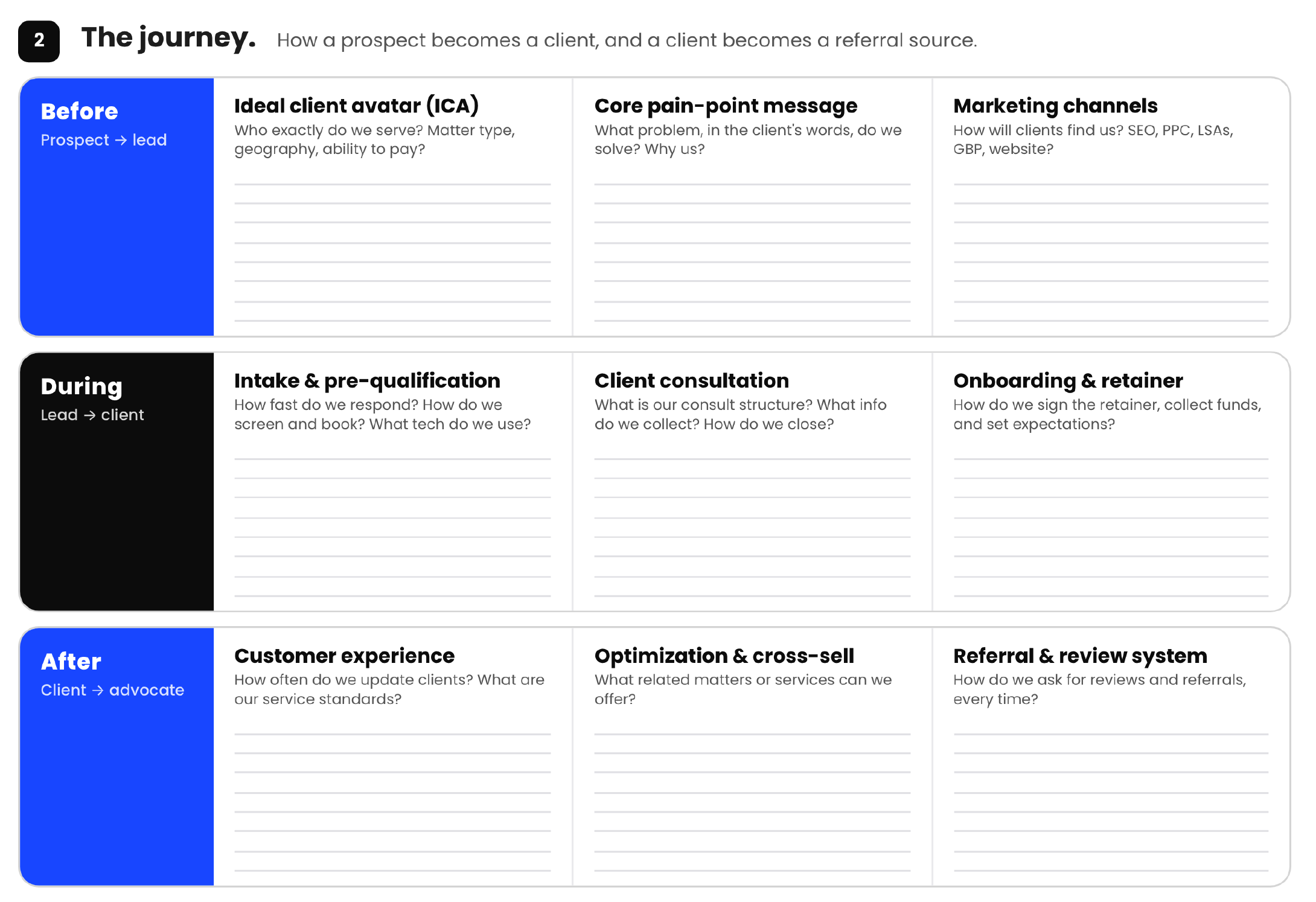
The metrics tell you how many leads you need. The journey section documents how those leads actually become clients, and how clients become referral sources.
I’ve split it into three stages with three boxes each.
The rule for every box: write operational answers, not aspirations. “Respond fast” is an aspiration. “Every lead gets a call within five minutes during business hours, and a text within one minute after hours” is an answer.
Before: prospect to lead
Ideal client avatar (ICA).
Who exactly do you serve? Practice area, service, geography, and private vs legal aid. “Anyone charged with anything” is not an avatar. “First-time DWI charges in Houston, employed, able to fund a $7,500 retainer” is.
Core pain-point message.
What problem, in the client’s own words, do you solve?
Clients do not search for “criminal litigation services.” They search for “will I lose my license” and “can I travel to the US with a DUI.”
Write the message in their language, then answer why you and not the firm down the street.
Marketing channels.
Where will these clients actually find you?
SEO, PPC, Local Services Ads, your Google Business Profile, your website.
List the channels where your audiences search for your services, not every channel that exists. Two channels done well beat six done poorly.
During: lead to client
Intake and pre-qualification.
How fast do you respond, how do you screen, and how do you book? Speed to lead is the highest-leverage variable in this whole section. Name the tech: your intake software, your booking tool, your after-hours coverage.
Client consultation.
What is the structure of the consult, what information do you collect, and how do you close? If every lawyer in the firm runs consults differently, your consult-to-matter rate in Section 1 is a coin flip. Standardize it.
Onboarding and retainer.
How does the retainer get signed and funded, and how do you set expectations? E-signature and online payment on the same day as the consult, or a paper agreement mailed next week? The gap between “yes” and “signed” is where matters die.
After: client to advocate
Customer experience.
How often do clients hear from you, and what are your service standards? Unreturned phone calls are the number one source of law society complaints and one-star reviews. Put your update cadence in writing.
Optimization and cross-sell.
What related matters or services can you offer? A record suspension after a criminal file closes. An estate plan after a real estate closing. This is revenue that requires zero new marketing spend.
Referral and review system.
How do you ask for reviews and referrals, every time? The key words are “system” and “every time.” An ask that depends on someone remembering is not a system. Build it into file closing. Explain your processes, and make it repeatable.
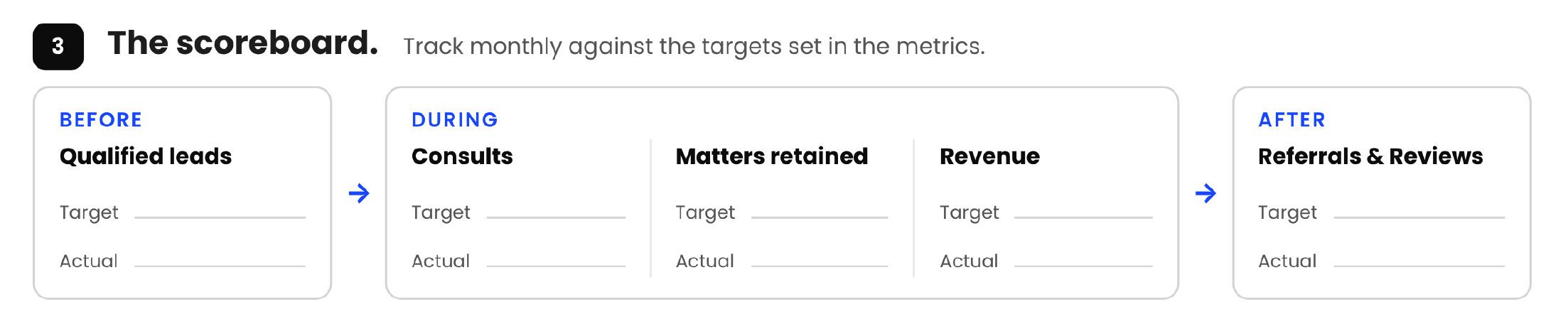
The scoreboard is four boxes: qualified leads, consults, matters retained, and revenue, plus referrals and reviews. Each has a target line and an actual line.
The targets are not new numbers. They come straight from Section 1, divided by 12.
In our example: 84 leads, 42 consults, 10 or 11 matters, and roughly $83,000 in revenue per month.
Fill in the target lines the day you complete the sheet. Fill in the actuals on the first business day of every month.
The value of the scoreboard is diagnostic.
When revenue misses, the scoreboard tells you which stage failed.
- Leads on target but consults low? Intake problem. Fix speed to lead and screening, not the ad budget.
- Consults on target but retained matters low? Closing problem. Fix the consultation structure.
- Leads themselves low? Now, and only now, is it a marketing problem.
Without the scoreboard, every miss looks like a marketing problem, and firms respond by changing agencies when the real leak was a receptionist who books consults three weeks out.
The one-page legal marketing plan is a free download. I’ve designed it to be completed in as little as one hour.
Most firm owners can finish the first section in fifteen minutes and learn more about their marketing economics than they have in years of agency reports.
And if you would rather not do it alone, get in touch with me.
Book a working session with Inbound Legal and we will fill out the sheet together using your firm’s real data, benchmark your cost per lead against your market, and flag the biggest leak in your funnel before you spend another dollar.

Written By: Calin Yablonski
Calin Yablonski is a veteran digital marketing strategist and the founder of Inbound Legal.
With over 15 years of experience specializing in high-performance SEO and lead generation, Calin has helped hundreds of professional service firms scale their online presence.
Previously the founder of Inbound Interactive and a recognized "Notable Young Entrepreneur," his expertise in legal marketing has been featured on legal platforms like Clio, Law Pay, Caret Legal, Practice Panther, The National Law Review, Bill 4 Time, Smith.ai, and more.