
On This Page
Law firms have various domain name options, but is a .com domain still the best one?
Over 15 years I’ve built or rebuilt 100 law firm websites, and every one of them is on a .com or a .ca. A few clients have asked me about a .law domain. For the most part, I’ve talked them out of using one, and below is the reasoning I gave them.
Niche legal domains like .law, .lawyer, .legal, or .attorney exist, but law firms, like most businesses, overwhelmingly opt for .com.
Verisign’s Domain Name Industry Brief for Q2 2026 puts .com at 166.6 million registrations as of June 30, 2026, making it by far the largest TLD in the world and the one with the highest brand recognition of any extension.
By comparison, .law had roughly 22,000 registrations and .lawyer roughly 8,500 in 2025, about 30,000 combined, according to Register.domains. .legal sits near 25,000 and .attorney under 5,000.
The question: should you break the mold and go with a niche domain or stick with the trusted .com format?
Let’s find out whether they’re worth registering, what the pros and cons of each are, and whether your choice will affect Google rankings or citations in AI overviews.
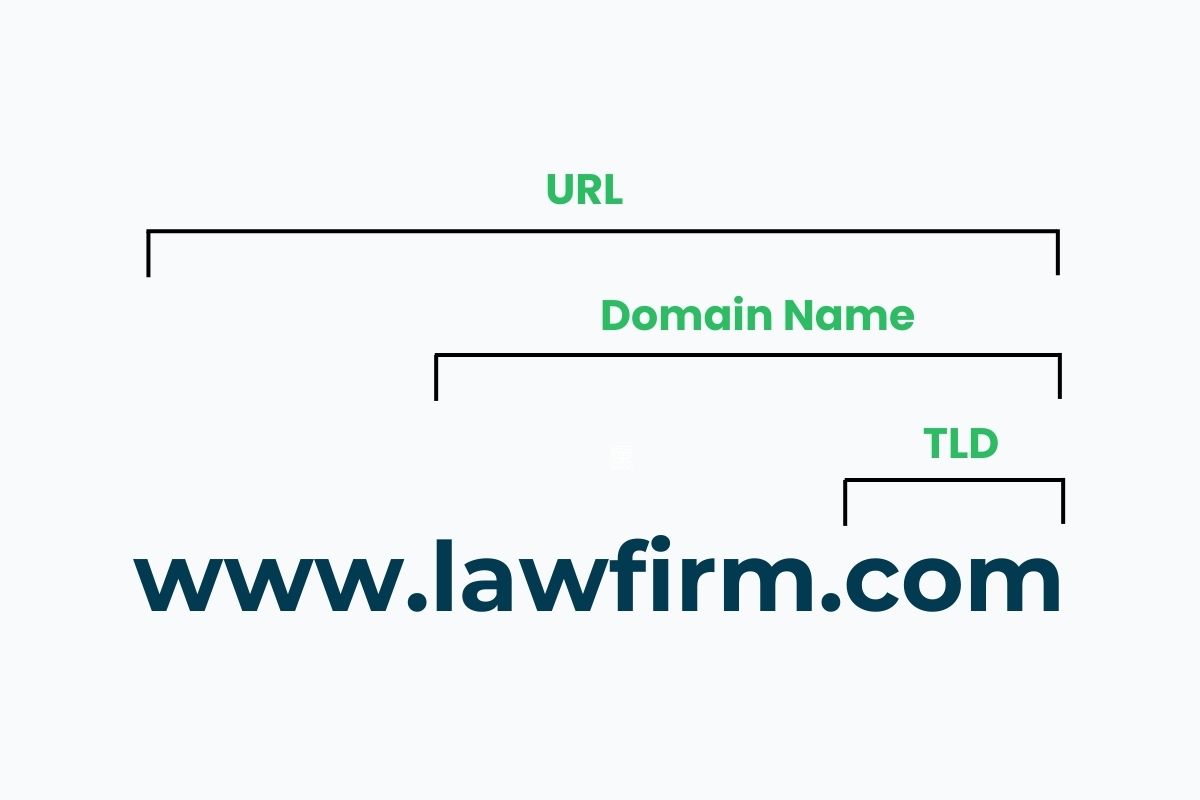
First, a few basic definitions:
- URL (Uniform Resource Locator): The complete web address (e.g., www.xyz.com).
- Domain name: The unique identifier (e.g., xyz.com, xyz.net, etc.).
- Top-Level Domain (TLD): The section of the domain name following the dot (e.g., .com, .ca, .co.uk), which is the main focus of this article.
How have domain names for law firms evolved?
Domain names have been around since 1985. The original set of generic TLDs was tiny (.com, .org, .net, .edu, .gov and .mil), with country-code TLDs like .ca and .co.uk added alongside them.
That changed with ICANN’s new gTLD program. Applications opened in 2012, the first new TLDs went live in late 2013, and more than 1,200 have been delegated since. .lawyer and .attorney launched in 2014, and .law and .legal followed in 2015.
John Morgan, founder of Morgan & Morgan and chairman of the .law registry when it launched in 2015, told the ABA Journal:
“It gives everybody the opportunity to have a one-time reset for the domain name of their dreams, and it will probably never happen again when you have a domain like this in a field like ours.”
That’s worth pausing on. The largest personal injury advertiser in the United States put his name behind .law, and a decade later it has around 22,000 registrations against .com’s 166 million.
Law firms can now identify themselves simply from their domain name extensions:
- .law
- .lawyer
- .attorney
- .legal
These are the main ones used by law firms in North America but firms have understandably proceeded with caution, as we shall see below.
Registration by numbers
Let’s quickly look at the registration volumes for the main legal domain names in 2025:
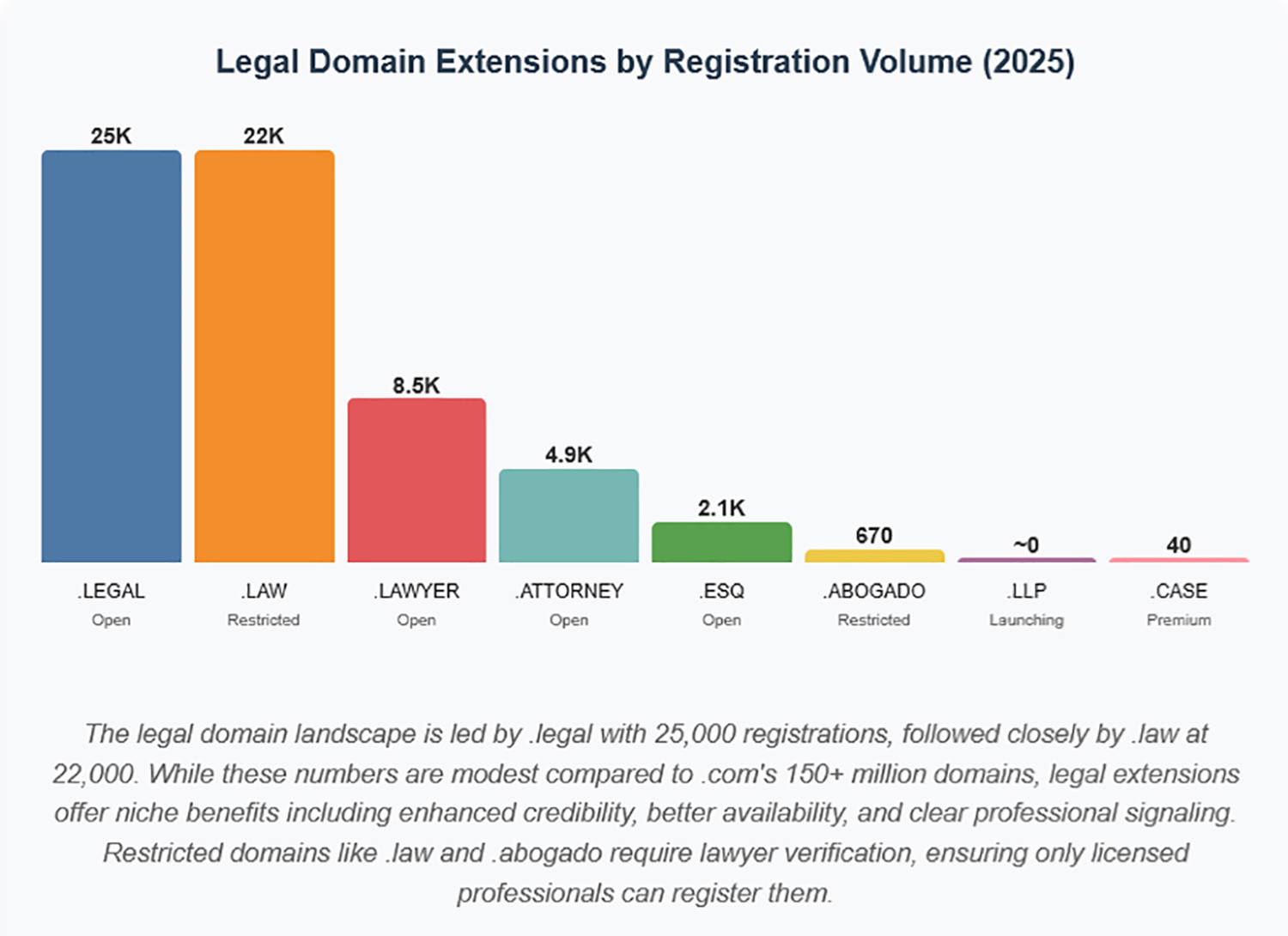
So, despite the fanfare of the release of new TLDs at the time, they comprehensively trail the ever-present and trusted .com domains for law firm registrations everywhere.
Who can register legal TLDs?
Some restrictions exist about who can register domain names pertaining to law firms, but not for all legal top-level domains.
This table explains who can register the main legal TLDs:
| Top-Level Domain | Registration Restrictions | Validation Required |
|---|---|---|
| .com | No restrictions | None |
| .lawyer | No restrictions | None |
| .attorney | No restrictions | None |
| .law |
|
Mandatory license proof via an independent check is required. |
| .legal | No restrictions | None |
Premium names (chicagodivorce.law and similar) are priced separately by the registry and can run into the thousands.
It’s easy to see that .law domain names should carry much more credibility and authority than the other available TLDs, because they are reserved for verified selected entities within the legal profession.
The other TLDs are freely available without requiring any legal credentials. This should be a major red flag to any credible law firm.
The annual costs also vary between these domains, though the differences should not be “deal breakers” for most firms.
| Domain | Year 1 Cost (USD) | Renewal Cost (USD) |
|---|---|---|
| .com | $9-18 | $14-22 |
| .lawyer | $50-95 | $60-90 |
| .attorney | $45-90 | $55-85 |
| .law | $80-130 | $100–160 |
| .legal | $20-40 | $30-55 |
NOTE: Registrars like GoDaddy offer first-year discounts, but the mandatory annual renewals rise 20–50%. Legal TLDs carry higher registry fees. Highly competitive domains (e.g., chicagodivorce.law) are much more expensive.
When .law launched in 2015 it cost about $200 a year plus a $10 verification fee (ABA Journal). Prices have since fallen by more than half, which tells you something about demand. Even so, a .law domain still costs several times what a .com does every year.
Initially, the new legal TLDs like .law and .lawyer were seen as a great way to boost law firm search rankings.
It hasn’t turned out that way.
Traditional law firm SEO thinking was that Exact Match Domains, such as denverfamily.lawyer or nycriminaldefense.attorney, would boost rankings for searches like Denver family lawyer or NY criminal defense attorney.
Google is smarter and more sophisticated than that, however.
Rankings can’t be bought that easily. Google works out that a site belongs to a law firm, and what kind, from the content itself, from schema markup (LegalService and Attorney types), from the Google Business Profile category, and from who links to the site and how. The letters after the dot don’t enter into it.
- Google Business Profiles
- Structured markup
- RankBrain
The Google search results page for Denver family lawyer ranks law firms with .com domains (rather than Exact Match Domains) the highest in the organic results:
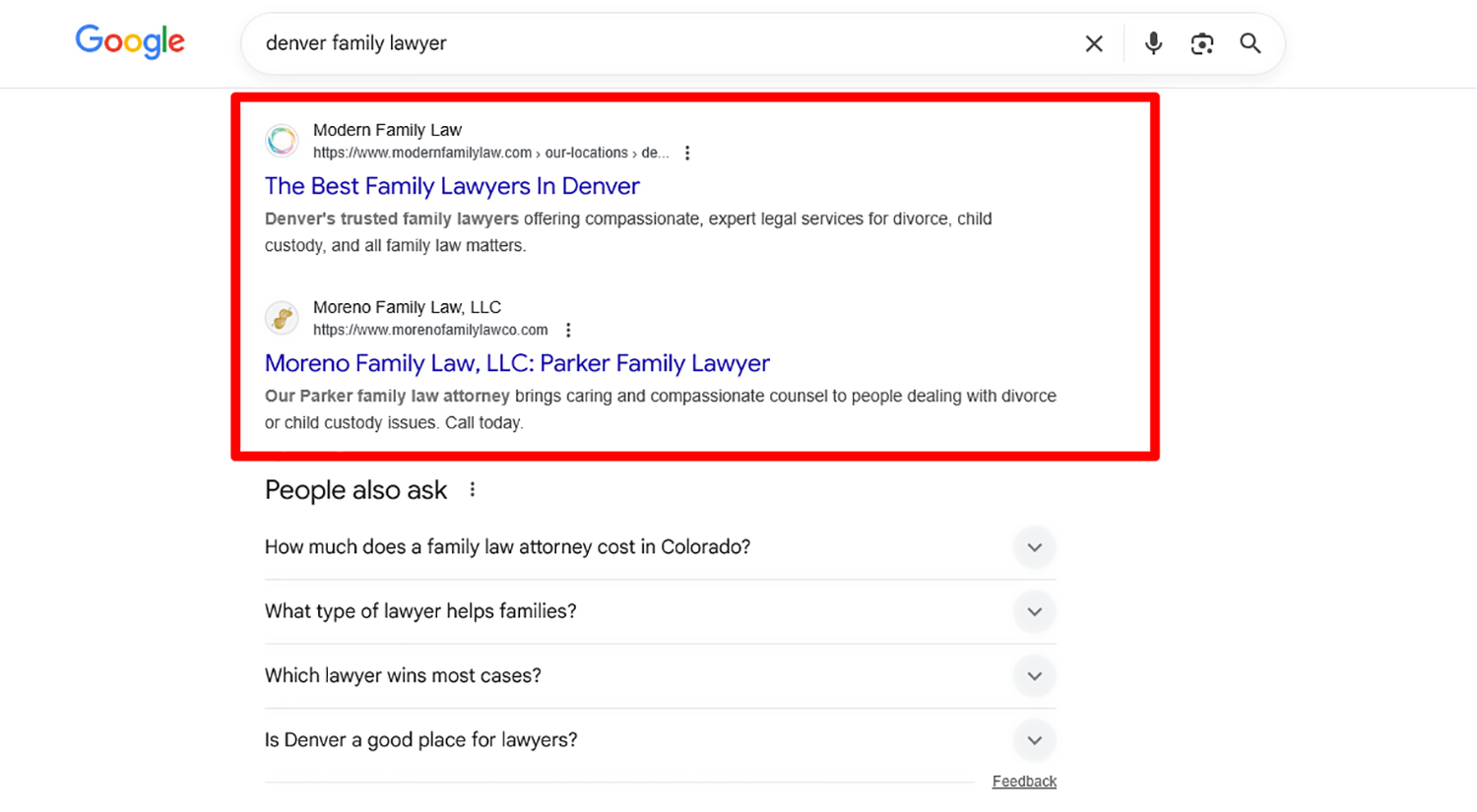
Google said this directly in a 2015 Search Central post on new top-level domains: new TLDs are treated the same as any other generic TLD, and keywords in a TLD give no ranking advantage.
John Mueller repeated it in a 2016 Webmaster Hangout (“The TLD is not something we take into account”), and nothing Google has published since has changed that position.
“The TLD is not something we take into account.”
The search results from then to the present date bear this out.
Consistently, the top-ranking law firms are those that use theirname.com but optimize their websites in other ways, primarily by demonstrating EEAT (Experience, Expertise, Authoritativeness, and Trustworthiness) through their content, onsite optimization, and backlinks. Our SEO for lawyers guide covers how.
Do TLDs impact citations in Google AI Overviews?
Let’s consider a search request for “What are the main defenses to DUI in Maine?” The two citations for law firms used in the overview and linked to in the right-hand panel are both .com domains.
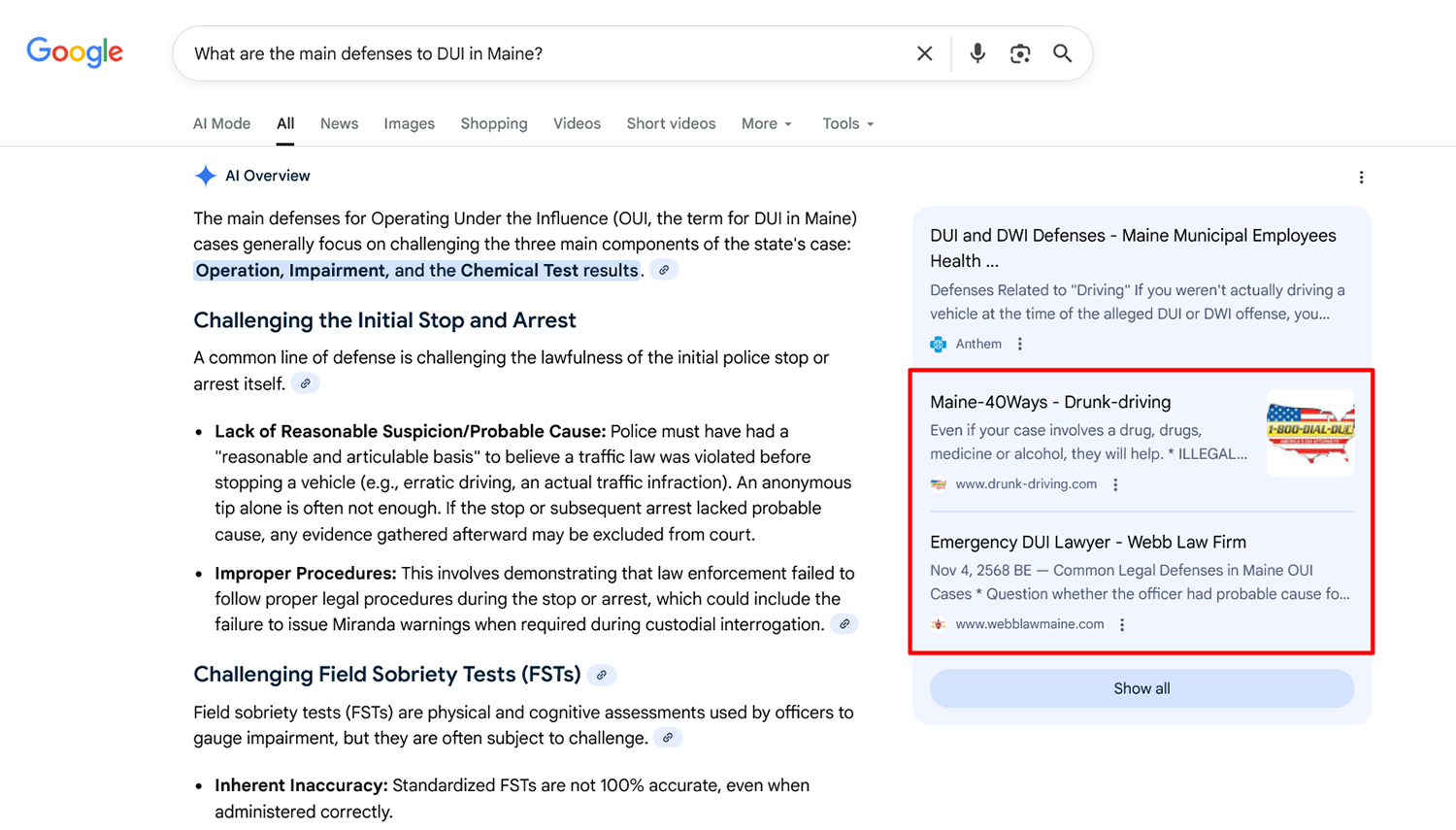
The fact that the Overview cites these sources is an indication of their high EEAT rating with Google.
While this is a tiny sample size of one example, we see this repeated over and over in Google’s AI Overviews for legal questions, i.e., no priority for .law, .lawyer, or any other domain name based on legal TLDs.
So, what are the main pros and cons of registering and using the various legal TLDs as opposed to a .com domain?
Pros
- Branding: These extensions immediately signal to users that your firm is in the legal industry, which can distinguish you from other businesses (but only if they look at the domain name).
- Credibility: .law registration and usage are restricted to licensed legal professionals, which effectively means that your firm is verified: instant credibility.
- Availability: If a preferred .com name is already taken (quite likely), a new law firm may be able to find availability with a .law domain.
Main Cons
- Expectations: Most people still expect to see .com domains, with generally low awareness of other name forms. They may be redirected to another firm when typing in the URL or become confused about which URL to use.
- Credibility/Practicality issues: .lawyer, .attorney, and .legal TLDs are almost useless for law firms as anyone can register them. These “vanity domains” serve little practical purpose.
- Professional Conduct Violations: A domain like bestdivorcelawyer.law or torontodui.attorney can fall foul of Law Society advertising rules.
Quite apart from these negative points, legal TLDs are more expensive than .com domains, an extra cost that provides little benefit.
In our view, even some of the advantages of legal TLDs also suggest some negatives.
For instance, if a firm’s main attempt to stand out in Florida immigration law is by registering a domain like immigrationmiami.law, the firm likely has other marketing issues. We would humbly suggest they read our law firm marketing article to follow a more comprehensive approach.
Don’t build your website on a legal TLD. But do consider registering yourbrand.law and pointing it at your main site. For under $100 a year it closes the one real risk these extensions create: someone else registering your firm’s name on .law or .lawyer and using it to catch misdirected clients or emails. If your firm name is distinctive, this is optional. If it’s generic (a surname, a city plus practice area), it’s cheap insurance.
The advantages of moving away from a trusted .com-based URL are few and far between for most law firms. That’s why the expected gold rush in law firm domain name suffixes never really happened, and you rarely see them today.
Law firms should focus on marketing strategies that get long-term results rather than distractions like attempted domain name “tricks” that won’t boost rankings anyway.
Inbound Legal builds and markets websites for law firms across Canada and the US. If you’re choosing a domain for a new firm or thinking about changing one, talk to us before you buy.

Written By: Calin Yablonski
Calin Yablonski is a veteran digital marketing strategist and the founder of Inbound Legal.
With over 15 years of experience specializing in high-performance SEO and lead generation, Calin has helped hundreds of professional service firms scale their online presence.
Previously the founder of Inbound Interactive and a recognized "Notable Young Entrepreneur," his expertise in legal marketing has been featured on legal platforms like Clio, Law Pay, Caret Legal, Practice Panther, The National Law Review, Bill 4 Time, Smith.ai, and more.